If you’re mid-flare right now, that’s all you need. But understanding why flares last as long as they do — and what actually speeds up resolution — is worth knowing for next time.
The Typical Gout Flare Timeline
Gout flares follow a fairly predictable pattern, even though they can feel completely unpredictable when they strike.
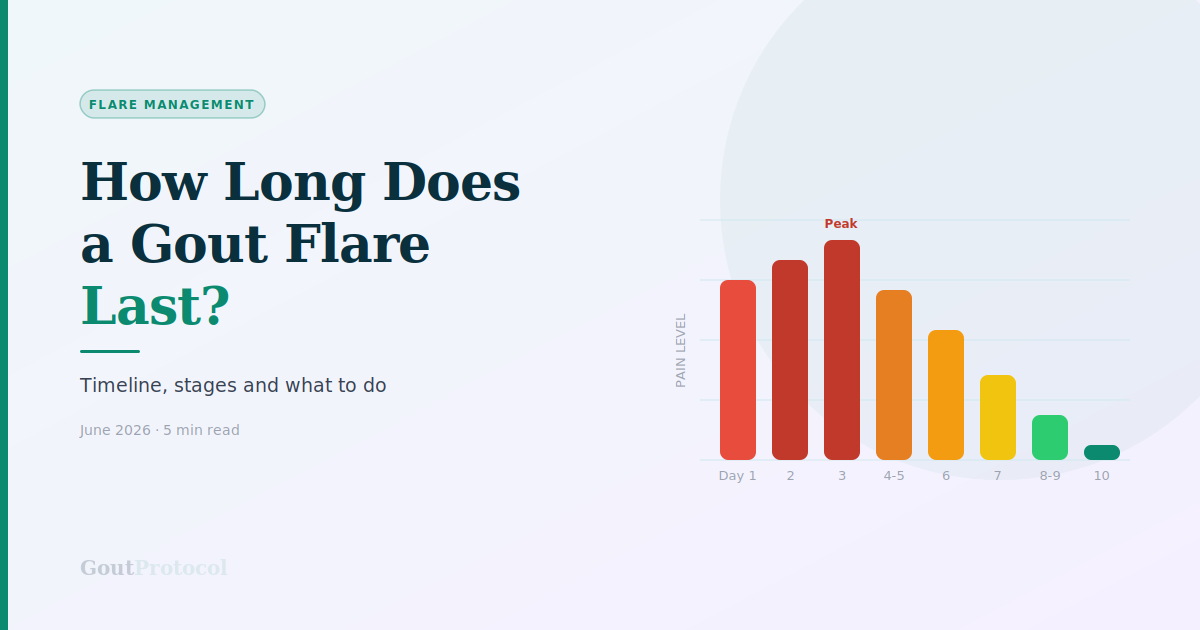
Hours 0–12: The flare begins. Often it starts overnight — uric acid crystals that have been accumulating in the joint trigger an immune response. The joint becomes warm, swollen, and increasingly painful. Many people describe the pain as reaching peak intensity within 12 hours of onset.
Hours 12–48: Peak pain. The affected joint is usually red, hot, and exquisitely tender. Even the weight of a bedsheet can be unbearable. Mobility is significantly reduced. This is when treatment makes the biggest difference — starting medication now can cut the total duration substantially.
Days 3–7: For most treated patients, inflammation starts to subside during this window. Swelling reduces, pain becomes more manageable, and movement returns gradually.
Days 7–14: In untreated or undertreated cases, the flare may still be active. The joint may begin to peel or itch as inflammation resolves — this is normal.
What Affects How Long a Flare Lasts?
Not all flares are equal. Several factors influence duration:
How quickly you treat it. This is the biggest variable within your control. Colchicine taken within the first 12 hours of a flare is significantly more effective than the same dose taken 36 hours in. NSAIDs work similarly — early is dramatically better than late.
Your baseline uric acid level. People with very high uric acid (above 9.0 mg/dL) tend to have more severe and longer-lasting flares, because there is more crystal load in the joint. Bringing uric acid down long-term is the single most effective way to shorten future flares.
Which joint is affected. The big toe (first metatarsophalangeal joint) is the classic location and tends to follow the standard timeline. Flares in larger joints — knee, ankle, wrist — can sometimes last longer and be harder to treat.
Whether you stay hydrated. Dehydration concentrates uric acid in the blood and slows its excretion. Drinking 2–3 litres of water during a flare actively supports resolution.
Alcohol consumption during the flare. Alcohol — especially beer — raises uric acid acutely and competes with the kidney’s ability to excrete it. Even one drink during an active flare can extend it meaningfully.
The Flare Emergency Protocol
This is the sequence to follow the moment a flare starts. Speed matters.
Step 1 — Medication immediately (within 12 hours):
- Colchicine — 1mg at onset, then 0.5mg one hour later (UK standard dose). Most effective option if you have it prescribed.
- Ibuprofen — 400–600mg three times daily with food if you don’t have colchicine. Don’t use if you have kidney issues or are on blood thinners.
- Naproxen — 500–750mg twice daily is an alternative NSAID often preferred for gout.
Step 2 — Hydration: Aim for 3 litres of water over the day. Uric acid is excreted by the kidneys — more water means more excretion.
Step 3 — Rest and elevate: Keep the affected joint elevated above heart level where possible. This reduces blood pooling and swelling.
Step 4 — Ice: 20 minutes on, 20 minutes off. Ice reduces acute inflammation and numbs pain. Do not apply directly to skin.
Step 5 — Eliminate triggers immediately: No alcohol, no red meat, no organ meat, no high-fructose drinks until the flare fully resolves.
When To See A Doctor
Most gout flares can be managed at home with the protocol above. See a GP if:
- The flare is not improving after 7–10 days despite treatment
- You have a fever above 38°C alongside joint pain (this may indicate infection, not gout)
- Multiple joints are affected simultaneously
- This is your third or more flare in a year — you should be on preventative urate-lowering medication
How To Prevent The Next One
The best way to shorten future flares is to reduce how often they happen. Every flare is preceded by sustained elevated uric acid — crystals don’t form overnight, they accumulate over months.
The core long-term strategy:
- Get your uric acid tested and aim below 6.0 mg/dL
- Eliminate fructose and reduce alcohol significantly
- Increase water intake permanently, not just during flares
- Consider tart cherry extract and vitamin C supplementation daily
- Discuss urate-lowering medication with your GP if you’ve had two or more flares
The Modern Gout Guide includes a full Flare Emergency Protocol with step-by-step instructions, plus the 90-day prevention plan to dramatically reduce how often flares occur.
Frequently Asked Questions
Can a gout flare last months?
Rarely, but it can happen — particularly in people with very high uric acid, untreated gout, or tophi (visible urate deposits). Chronic tophaceous gout can cause persistent joint inflammation. If your flare hasn’t resolved in 3 weeks, see a rheumatologist.
Is it normal to have multiple flares close together?
It’s common but not normal — meaning it happens frequently but it’s a signal that uric acid is poorly controlled. Having two or more flares per year is a clinical indication for urate-lowering therapy.
Why do gout flares often start at night?
Several reasons: body temperature drops slightly during sleep, which lowers the solubility of uric acid and encourages crystal formation. Dehydration overnight also concentrates uric acid. And cortisol — which has mild anti-inflammatory effects — is lower at night.
Can you exercise during a gout flare?
Not on the affected joint. Rest the joint completely during the acute phase. Light upper body movement or walking (if the flare is not in a foot or ankle joint) is fine, but don’t push through pain — it prolongs inflammation.
Does ibuprofen or paracetamol work better for gout?
Ibuprofen significantly outperforms paracetamol for gout. Gout pain is driven by inflammation, and ibuprofen is an anti-inflammatory. Paracetamol is purely analgesic — it reduces pain sensation but does nothing for the underlying inflammation causing it.
Sources
- Richette P, et al. 2016 updated EULAR evidence-based recommendations for the management of gout. Annals of the Rheumatic Diseases. 2017;76(1):29–42.
- Khanna D, et al. 2012 American College of Rheumatology Guidelines for Management of Gout. Arthritis Care & Research. 2012;64(10):1431–1461.
- Stamp LK, et al. Starting dose is a risk factor for allopurinol hypersensitivity syndrome: a proposed safe starting dose of allopurinol. Arthritis & Rheumatism. 2012;64(8):2529–2536.
- McCarty KL, Gaffo AL, Diaz-Torne C. Gout therapy updated. Current Opinion in Rheumatology. 2024.